

How Free Is Free Speech? On Lisa Spencer, One Nation, and Who Gets Protected

More on the Lisa Spencer topic.
I stepped away, traveled from London to The Netherlands to start a training and have had to seal up that conversation for a couple of days.
But just today, some thoughts were percolating within me, on the topic, and I want to share them with you.
One of the first conversations I want to have with you: the topic of free speech.
A few people have been sharing, that they believe that despite her content being explicitly racist, that she too has the right to free speech, and shouldn’t be cancelled.
And this argument got me thinking: how free is speech, exactly, when the people harmed by it are among the least protected in this country?
Aboriginal Australians are a community that has survived genocide, the Stolen Generations, and the ongoing, grinding indignity of systemic racism — and they are being caricatured, mocked, and reduced to stereotype for the entertainment of an audience. And we are talking about the people who created and cheered that content invoking freedom as their defence. And not only that, but we are talking about a political climate in which that invocation is becoming increasingly loud, confiendent and what I would name as dangerous.
What Actually Happened
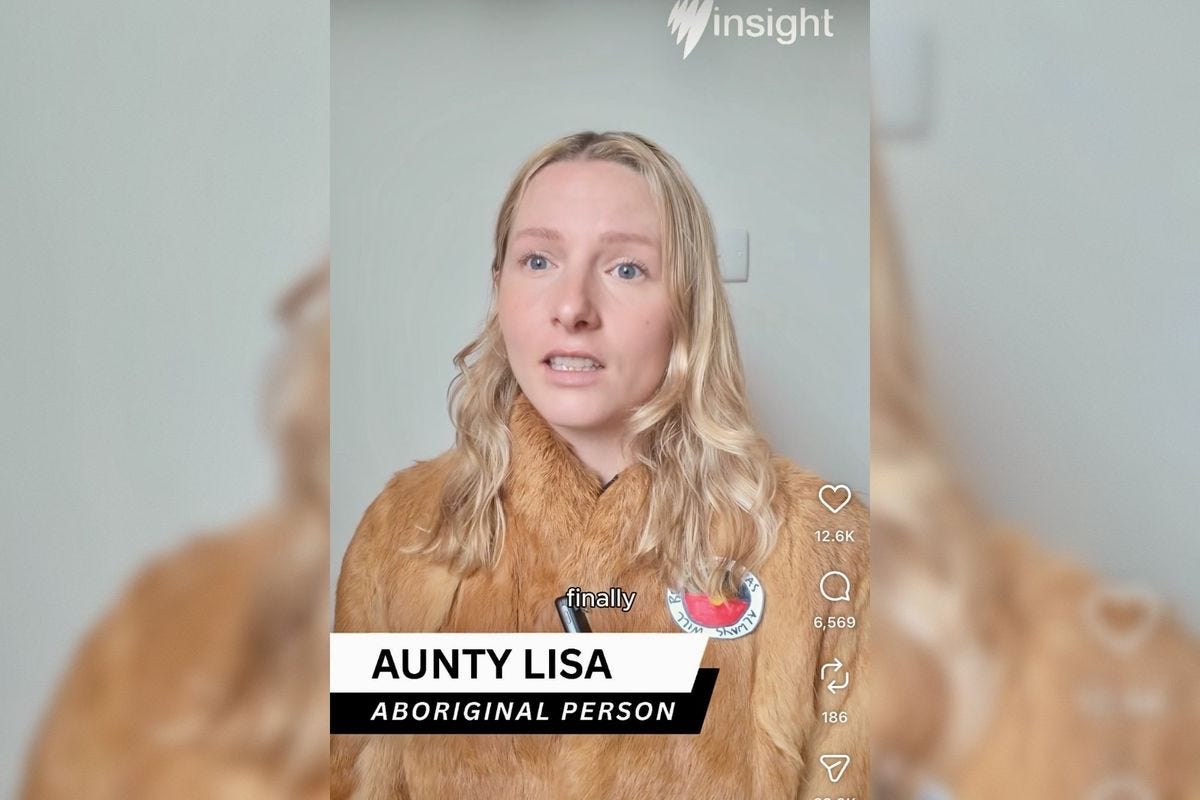
Lisa Spencer created “satirical” content targeting Aboriginal Australian people. She has since offered a defence — that it was satire, born of frustration with government immigration policy and what she describes as diversity being “pushed onto her.”
A commenter on my page stated:
“She made a video explaining her intention behind her latest satire is because she is angry at the government and their immigration policies. She also states clearly in that video that she feels diversity is being pushed onto her. You would think she would make satire about politicians and their policies, but instead she chose to cosplay Aboriginal and Indian people. Sniffing petrol reinforces harmful stereotypes. If you take the time to look at her videos and her explanation video you would see that she has severely negative views about immigrants.”
Satire is a literary and artistic tradition with a specific anatomy. It uses irony, exaggeration, and humour to critique power — to expose the failures of institutions, governments, and people who hold authority over others. Swift’s A Modest Proposal was satire: it mimicked the cold logic of British colonial policy to reveal its monstrousness. The Daily Show is satire. Yes Minister is satire. The target is always, in genuine satire, upward — those with more power, more privilege, more capacity to absorb the blow.
What Lisa Spencer created does not meet that definition. Not even loosely.
She has stated that her frustration is with government immigration policy — with politicians, with legislation, with decisions made in Canberra. If that frustration were the engine of actual satire, the target would be the politicians. The bureaucrats. The architects of the policy she opposes. Instead, she chose to cosplay Aboriginal Australians and Indians. She chose to deploy the petrol-sniffing stereotype — one of the most dehumanising and enduring weapons used against Aboriginal people in this country.
That is not satire. That is the scapegoating of the most vulnerable people in the vicinity of someone’s anger. It is the oldest move in the playbook: you are upset with the people in power, so you punch at the people with the least. The word “satire” doesn’t sanitise that. It doesn’t elevate it into art. It is a costume the content is wearing, and it doesn’t fit.
Satire requires a target that can fight back. Aboriginal Australians — a community of roughly 800,000 people in a country of 26 million, carrying the accumulated weight of two centuries of colonial violence — are not that target. They are, in every structural sense, the opposite of that target.
Calling this satire is not a defence. It is a misdirection. And we should name it as such.
And here is the thing… if your grievance is with a political system, and the vessel you choose to express it through is the caricature of Indigenous people and immigrants — you have revealed something about what you actually think. Satire aimed at power moves upward. What Lisa Spencer created moved downward, toward people who already carry more than their share of this country’s cruelty.
She lost her job. That is a consequence. Consequences are not persecution. They are not a violation of free speech. They are what happens when speech causes documented harm and an employer decides they do not want to be associated with it.
She then raised over $40,000 on GiveSendGo. I want you to hold both of those facts in your hands at once and feel the weight of what they tell us; about this moment, about this country, about what we are willing to reward.
A Note on “Free Speech”
Free speech, as a principle, exists to protect the individual from the silencing power of the state. It was never designed to mean that speech is without consequence, or that platforms are obligated to host it, or that employers must retain people whose public conduct causes harm. That is not free speech. That is impunity dressed in the language of liberty.
But there is a deeper problem with how free speech is being invoked here, and it is this: the people invoking it are almost never the people paying its price.
Lisa Spencer still has a voice. She still has an audience. She raised over $40,000.
Whose speech, in this story, is actually free? And whose freedom is being protected when we rally behind the right to create content like this without consequence?
I have received private messages from Aboriginal people who told me it felt meaningful to see someone white speak up for them. Not because they need saving — they do not, and that framing would be its own kind of condescension. But because engaging with this kind of content publicly, when you are the one it targets, is like pressing salt into an open wound. It demands that the harmed person re-enter and fae off with their original wounds. That they educate the audience that hurt them.
That is an enormous ask. It is, frequently, an unfair one.
So if I have a platform, and relative insulation from the specific wound being inflicted, choosing silence is not neutrality. It is a posture. And I would rather be accountable for the posture I choose.
The Precipice we are on
I want to speak to something else, that has been eerily nagging at me.
One Nation is rising in Australia and has built its platform on the same emotional frame that animated Lisa Spencer's content: the idea that certain Australians are being displaced, that diversity is an imposition, that some people's discomfort with a changing country matters more than other people's right to belong to it.
When content like Lisa Spencer's gains traction — and tens of thousands of new followers and $40,000 is traction — it does not exist in a vacuum. It exists in a political climate where this sentiment is being courted, amplified, and legitimised.
I think about Aboriginal and also immigrant communities watching this whole sitiation unfold in sequence… The content being made. The job being lost. The internet rushing to her defence. The money flowing in. If you view that sequence through the lens of a community that has watched this country’s political winds shift before — that has lived through what happens when those winds turn — the $40,000 is not just a fundraiser. It is both salt on an open wound, and it is also a signal.
And if One Nation continues its ascent, that signal gets louder. The emboldening compounds. I don’t think we can afford to look away from what that means.
What Is Racism Actually For?
And lastly, I want to end on a question — one that has been circling on my mind all of today.
What does racism provide the people who practice it?
Because if we want to move through this — not manage it, not push back against isolated incidents, but actually evolve past it as a culture — we have to understand its function.
Racism offers a hierarchy in which your position feels stable. It offers a target for economic anxiety, cultural dislocation, the grief of a world that keeps changing in ways that feel threatening. It offers, sometimes, the ugly warmth of a shared enemy.
But none of those needs are actually met by racism. The anxiety doesn't resolve. The grief doesn't lift. The world keeps changing regardless. You are left with the same wounds, and the additional weight of the harm you caused.
We are not a species incapable of evolution. We have done it, across countless domains, often in the face of people who insisted it was impossible. The claim that the cruelty behind racism is somehow immovable — that it is simply how some people are — is not realism. It is a failure of imagination; one we cannot afford right now.
Do better. Because the alternative — the country that is taking shape if we don’t — is one that none of us, including the people currently cheering for it, actually want to inhabit.
.