Help me turn writing into a career, not just something I do on the side. Your paid subscription helps me carve out real time for essays — the deeper, slower pieces that I can take my time to write whilst I sip my Oolong in the morning.
Paid subscribers get early (and full) access to new essays, occasional behind-the-scenes notes on what I’m working through & monthly live guest speaker interviews. I hope you enjoy this article.
Big love,
SB x
I cried last night, watching videos of Kevin Reddington, Lindsey Clancy’s lawyer, standing for her and advocating for the failure and disregard of the system and those around her, for providing her with the care she needed post partum, as she was journeying through severe post partum psychosis.
I have so much to unpack with this case, and how this is creating the stage for us collectively to really witness this huge open gaping wound and shadow we have as a collective around postpartum care and the fragility and vulnerability of women in the fourth trimester.
But before I start, let me share more about the case and why it matters to me.
First of all, I am a Mother and I have intimately journeying these ways in which our society negates birth trauma, postpartum depression and mental health (although I refer to it as postpartum depletion, the term my doctor and teacher Dr Oscar Serralach coined). I have journeyed it myself, experiencing postpartum depression and PTSD after the intense emotional stress I experienced in pregnancy and early postpartum — I write about my journey intimately in my book The MotherWild Revolution: Cultural Change through Generational Activism, which is a available worldwide throughout book stores. This book was designed to speak to the collective shadows of the West, which turn away from pregnancy and matrescence, often leaving women, like Lindsey Clancy, unsupported and having to adjust to the changes of Motherhood alone, without the web of nourishment needed to actually thrive (or even survive, in this case) the postpartum period.
Not nearly enough of us are talking about how harrowing the experiences of early postpartum / the fourth trimester are… we are expected to just pick back up again, with no sleep, with a child on us that needs us every minute of the day. It is impossible without a wider web of community support. And yet, here we are — and we are paying the consequences of it — and this case is the perfect mirror for us to look at this collective blind spot, right now, and urgently.
The context.
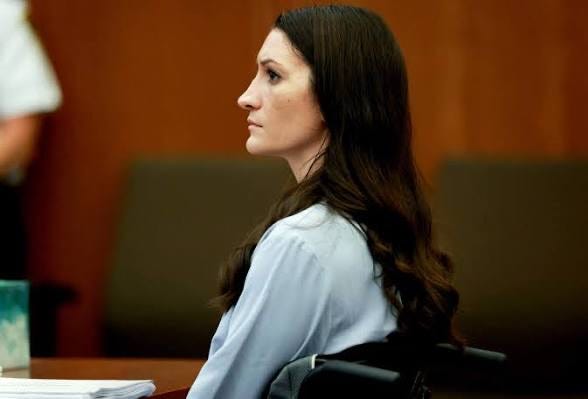
Right now, in a courtroom in Plymouth, Massachusetts, a woman named Lindsay Clancy is on trial for the deaths of her three children. Her defense argues she was in the grip of postpartum psychosis when it happened — a rare, catastrophic break from reality that can develop with terrifying speed in the weeks after birth. The prosecution argues she is criminally responsible regardless. The public has split itself, predictably, into the same two camps it always forms around a mother's unthinkable act: monster, or victim of a system that had every chance to catch her and didn't.
I'm not interested in relitigating her guilt. I'm interested in the fact that this case has become the only occasion, apparently, on which we're willing to talk about what childbirth does to the nervous system.
Postpartum psychosis is rare. It affects somewhere between one and two women per thousand births. It is not what I want to write about today, because focusing there lets us treat Clancy as an outlier — a devastating but statistically remote event, contained, explicable, over there. What I want to write about is the condition sitting underneath it, wearing no headlines, affecting a population roughly a hundred times larger, and going almost entirely unscreened for. It has a name now. It's called CB-PTSD — childbirth-related post-traumatic stress disorder — and the fact that most women have never heard of it is itself the diagnosis.
I have been immersing myself into the study of CB- PTSD since my own transition into Motherhood, in formal studies and training in Matriarchal Medicine, a body of work created by Dr. Oscar Serralach, who is spear heading this collective issue and educating healthcare practitioners like myself, worldwide with this wisdom. I highly recommend reading his book: The Postnatal Depletion Cure.
What CB-PTSD actually is
CB-PTSD is PTSD, full stop, with childbirth as the precipitating trauma. It meets the same clinical architecture as any other post-traumatic response: intrusive re-experiencing of the birth through flashbacks or nightmares, avoidance of anything that recalls it, negative shifts in mood and self-perception, and a nervous system locked in hyperarousal — the exhausted, wired, can't-put-the-baby-down-and-can't-rest-either state that gets waved off as "new mother anxiety" because nobody thought to ask what happened in the delivery room. And with more and more women opting for non-natural deliveries (which radically increase the incidence of CB PTSD), we are seeing an epidemic of women who are not coping.
The numbers are not marginal.
Across the general postpartum population, somewhere between five and six percent of women meet full diagnostic criteria — which translates to roughly 240,000 American women a year, and by some estimates 6.6 million mothers worldwide annually, plus another 1.7 million fathers and co-parents carrying trauma from witnessing it. Among women whose deliveries were medically complicated or experienced as traumatic, that rate climbs to somewhere between eighteen and forty-one percent. Black and Latinx women are roughly three times more likely to develop an acute traumatic stress response to birth than white women, which tells you plainly that this isn't only a psychiatric question. It's a question of who gets listened to, whose pain gets treated as data, and whose gets treated as drama.
None of this requires a catastrophic or unusual birth to take root. A birth can look, on paper, like a clinical success — live baby, discharged on schedule, no chart flags — and still leave the person who delivered it with a nervous system that has filed the experience under threat to life. Trauma is not defined by what the obstetric record says happened. It's defined by what the body decided happened.
The six-week appointment is a joke, and not a funny one
Here is the part that should make you angry rather than sad. The standard of postpartum care in most of the developed world is a single check-up at six weeks. One appointment, typically fifteen minutes, typically focused on the incision or the stitches or whether contraception has been discussed, often using a screening tool — the EPDS — that was built to catch depression and anxiety and was never designed to detect trauma at all. Reproductive psychiatrists have pointed out plainly that this system is "not going to catch people who are at risk of symptoms," only those already presenting in that narrow window. And the period researchers now identify as highest-risk — six to eight weeks postpartum — sits right at the edge of when we stop looking.
So a woman can leave the hospital with unprocessed terror lodged in her body, receive no trauma screening whatsoever, be handed a mood questionnaire she may not even correctly represent because dissociation and hyperarousal don't always look like sadness, get cleared, and be sent home to raise an infant while her body runs a threat-response loop nobody named for her. This is not a gap in the system. This is the system working exactly as designed, and the design was never built around the actual physiology of birth.
Birth is a bodily event before it is anything else
Birth is not a medical event that happens to also involve a body. It is a bodily event, one of the most extreme the human nervous system will ever undergo, that we have chosen to administer medically. Those are not the same thing, and the difference matters enormously for how we prepare people for it, how we witness them through it, and how we care for them after.
We already know, from decades of trauma literature that has nothing to do with childbirth, that an event doesn't need to be freak or rare to overwhelm the nervous system's capacity to metabolize it. It needs to involve a perceived threat to life or bodily integrity, insufficient support in the moment, and no adequate discharge afterward. Childbirth can satisfy every one of those conditions inside a hospital room that everyone in it considers routine. Untreated, that unmetabolized activation doesn't just sit quietly. It reshapes the mother-infant bond, since the infant himself can become a living trigger for the very event the body is still trying to survive. It disrupts breastfeeding. It corrodes partnerships. It makes a second pregnancy something to be feared rather than chosen freely.
What treating birth as trauma would actually require
Not a hashtag. Not another awareness week. It would require validated trauma screening — not just depression screening — built into postpartum visits, administered at the moment we now know the risk peaks, not six weeks too early. It would require obstetric and midwifery staff trained to recognize peritraumatic distress as it's happening in real time, in the room, rather than retroactively, once someone has already unraveled. It would require treatment pathways — trauma-focused therapies with a track record here, EMDR among them — that are actually funded and actually accessible, rather than something a woman has to self-diagnose her way into finding. And it would require, underneath all of it, a cultural willingness to say the sentence that somatic practitioners have been saying quietly for years and obstetric medicine still mostly won't: that a live baby and a healthy chart are not proof that nothing traumatic happened.
Not only that, it requires collective gaze and collective change towards understanding the fourth trimester, the changes in the brain and nervous system that happen with Matrescence, and a collective leaning into this issue, to create better supports for women to be nourished, held, and to have time off to breathe and adjust to a new life postpartum.
Because we do not “return to normal” — this is a permanent change, and a huge adjustment. And it needs to be treated as such.
Lindsay Clancy's trial will end the way it ends. Whatever verdict comes down, it will not touch the deeper failure underneath it — the one where hundreds of thousands of women a year are sent home from the place they gave birth with no name for what's happening in their bodies, no one who screened for it, and no plan beyond "see you at six weeks." I don't know what is going to happen in that courtroom, but I do know that if we keep treating the fourth trimester as an administrative afterthought instead of the acute nervous-system event it is, we will keep manufacturing the exact conditions that produce catastrophe, and we will keep being shocked when it arrives.
The cracks were always going to surface eventually. I'd rather we looked at them before the next one does.