


There is a cruelty that lives inside the story of Gisèle and Caroline Pelicot — one that gets swallowed by the larger, louder narrative of courage and conviction.
We know what Gisèle endured. Her husband, Dominique Pelicot, systematically drugged and raped her for nearly a decade, inviting strangers into their home while she lay unconscious. She waived her right to anonymity. She insisted the trial remain public. She stood in front of the world and said: the shame belongs to the perpetrators, not to me. That was an incredibly brave and extraordinary act of courage.
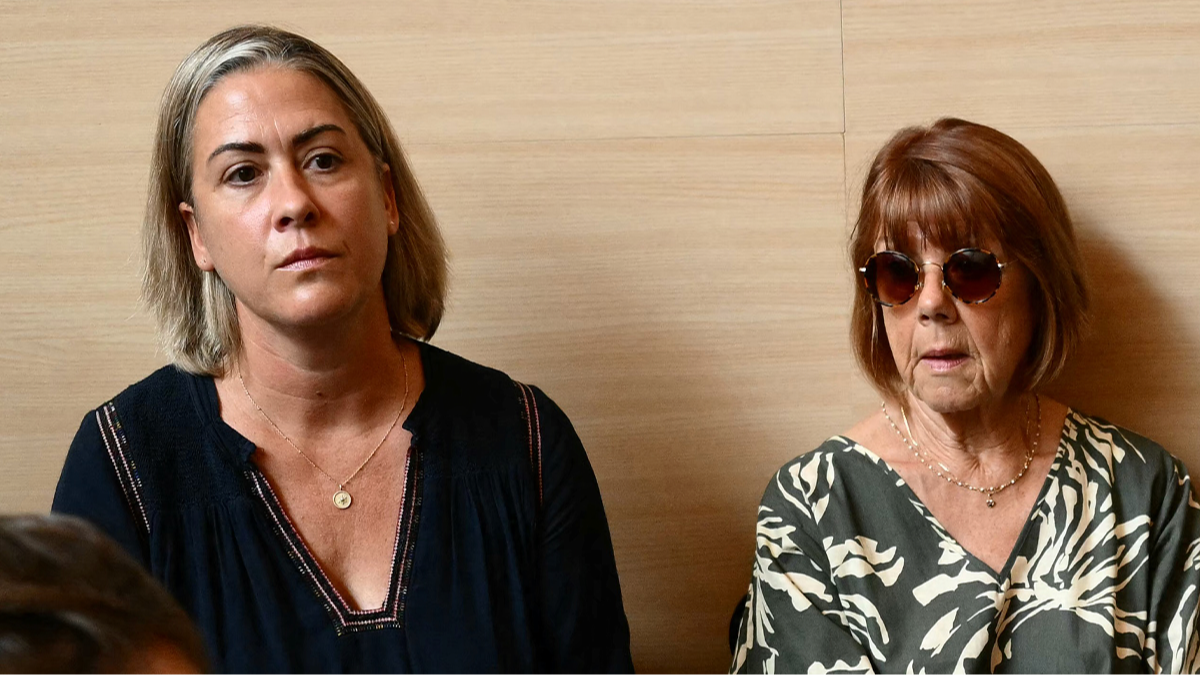
But there is another woman in this story. Her daughter, Caroline Darian, who sat beside her mother in that courtroom, who had spent four years accompanying her through every unbearable revelation — and who, when she surfaced her own trauma, was allegedly met with the words: "Stop making a spectacle of yourself."
And then: “Your father is incapable of such a thing.”
Sit with that for a moment — how does that make you feel?
For me, my gut sinks when I hear these words, particularly coming from her Mother— and even more so, given the nature of what she had herself endured.
"For four years I accompanied my mum everywhere. I supported her without ever judging her. And it wasn't always easy because she didn't want to hear what I was telling her."
— Caroline Darian
What the psyche cannot hold
Trauma psychology has a concept called the window of tolerance — the bandwidth within which a person can process difficult information without collapsing into overwhelm or shutting down entirely. Gisèle's window, in those years, was already holding the near-impossible.
Her entire marital reality had been erased. Fifty years of shared life. The man she had breakfast with that morning. The father of her children. The person she had built a world with was revealed, in a single day, to be a systematic predator. The scope of what she had to metabolise — cognitively, somatically, relationally — was already total.
And then her daughter came to her and said: I think he did it to me too.
To receive that — to truly receive it — would have required Gisèle to expand her capacity for horror at the very moment when it was already at its absolute limit. It would have meant accepting that the betrayal went deeper still. That her daughter, too, had been harmed under her roof. That she had not only been a victim but, without her knowledge, an unwitting keeper of conditions in which another victim lived.
This is a description of a human psyche protecting itself from disintegration.
Disavowal: knowing and not knowing, simultaneously
What Gisèle demonstrated is something psychoanalysis calls disavowal — a more sophisticated defence than simple denial. Denial says: this is not true. Disavowal says: I know this is true, and I will act as though it is not.
It is the split that occurs when the truth is both known and unbearable. The psyche holds the knowledge at arm’s length, allows it to exist somewhere in the background, and simultaneously refuses to let it become conscious reality. It is an act of psychic survival, not an act of cruelty — even when, from the outside, it functions as both.
For Caroline, her mother’s disavowal was deeply wounding precisely because of the intimacy of it. She had been her mother’s witness. She had sat with the unbearable. And when she needed that same witnessing returned, it was withheld — not by a stranger, but by the person she had given herself to most completely.
“My mother let go of my hand in that courtroom. She abandoned me.”
What disavowal costs the one who practises it
There is a tendency to frame disavowal as a kind of protection — and it is. But protection always has a price. What Gisèle could not let herself know did not disappear — it was just buried. And what is buried in the psyche does not rest quietly. It pressurises. It shapes behaviour from below the threshold of awareness. It finds expression in the very dismissals she offered her daughter — stop making a spectacle of yourself — words that carry the force of something being held back, not simply something being said.
Jung called this the shadow; the shadow being the sum of everything the conscious self cannot integrate. In Gisèle’s case, the shadow held the possibility that the man she had loved for fifty years had violated not only her body but her daughter’s. That the home she had kept was a site of harm she had not seen. The shadow held her own complicity — not moral complicity, but the unbearable proximity of it. That knowledge, unmetabolised, became what she turned against Caroline.
This is one of the shadow’s cruelest mechanics: we most fiercely reject in others what we cannot bear to see in ourselves. Gisèle could not afford to witness Caroline’s truth because to witness it was to integrate her own. And so Caroline became — in the logic of the unconscious — a threat to be silenced rather than a daughter to be held.
The shadow does not disappear when we refuse it. It simply finds another place to live — often inside the people we love most.
The mother-daughter wound
In Jungian psychology, the mother-daughter relationship carries a particular archetypal weight. It is the original mirror. The first place a daughter learns whether her experience is real, whether her body can be trusted, whether she will be believed when she speaks from the depths of herself.
When that mirror fails — when the mother cannot reflect the daughter’s truth back to her — the wound is not simply emotional. It is ontological. It touches the daughter’s sense of what is real. Caroline had already been violated by her father. And then she was disbelieved by her mother. The two wounds work in terrible concert: the first said your body is not your own, and the second said your experience does not exist.
What makes this rupture so specific to the mother-daughter bond is the history of devotion that preceded it. Caroline had spent four years as Gisèle’s witness — accompanying her, supporting her, holding her pain without judgment. She had, in a very real sense, mothered her mother through the unsurvivable. And when she finally needed that reciprocated, the well was dry. She became self-protective in ways that look, from the outside, like abandonment.
"For four years I accompanied my mum everywhere. I supported her without ever judging her. And it wasn't always easy because she didn't want to hear what I was telling her."
— Caroline Darian
What it takes to finally let the truth in
Jung wrote that we cannot transform what we will not face. The integration of shadow material is not an intellectual exercise — it is a somatic, relational, often shattering process. It requires, first, that the psyche develop enough capacity to hold what it previously could not. That capacity is rarely built in crisis. It is built in the aftermath, in the slow return to something like safety, in the presence of witnesses who do not need you to be coherent.
Something in Gisèle appears to be shifting. She has spoken of nagging doubt. Of reaching back toward her daughter. The phone calls — first at Christmas, then on Caroline’s birthday — are small, but they are not nothing. Her memoir names the photographs taken of Caroline as carrying an “unbearable incestuous gaze” — this appears to be the language of someone who has begun, at last, to let the knowledge in.
This is what shadow integration looks like in practice. Often it is not a clean admission, but a slow, costly opening — the psyche expanding, millimetre by millimetre, toward what it once had to refuse. It is a slow titration to be able to hold truth.
For Caroline, who has lived for six years in the particular hell of being certain without proof, waiting for her mother’s acknowledgment may have been its own form of witness. The body that carries a truth no one will confirm is a body in a kind of solitary confinement. To be believed — even partially, even belatedly — is not resolution. But it is the beginning of being able to breathe.
Published in The Soft Body Revolution · Written by Sigourney Belle Weldon
I appreciate you writing about this aspect and this is where my compassion goes flat because I have sat with too many women over the years whose mothers knew. I frankly find it a little bit hard to digest that a person could so effectively and severely detach from their body through that much abuse that the residual signals could be so effectively buried to create total amnesia, but then to come to terms what happened to you and deny your own daughter...nah bitch, nah. Not here not to me. Call it empathy fatigue or what have you, but no.
Scorpio full moon perfection