


Help me turn writing into a career, not just something I do on the side. Your paid subscription helps me carve out real time for essays — the deeper, slower pieces that I can take my time to write whilst I sip my Oolong in the morning.
Paid subscribers get early (and full) access to new essays, occasional behind-the-scenes notes on what I’m working through & monthly live guest speaker interviews. I hope you enjoy this article.
Big love,
SB x
True beauty is an upwelling, and no serum will do it justice.
Some women enter a room, features plain and her outfit unremarkable — and yet, the whole energy of the space shifts and reorganises itself.
A woman connected to her sexual prowess and deep feminine well, knows that this is no coincidence.
However most reach for this kind of radiance and feminine magnetism through external measures — by changing our outer appearance, buying a new outfit, through cosmetic surgery, layers of makeup. The faux feminine.
As someone who’s lineage and ancestral background is rooted in Traditional Chinese Medicine and Daoism, with training in these fields and also deep immersion into the field of Tantra in this lifetime, I want to explain this phenomena a little from more of an Esoteric perspective.
In Chinese medicine it is Jīng (精) — Essence — the most precious and most material of the Sān Bǎo, the Three Treasures, alongside Qì and Shén. Of the three, Jing is the densest and the most finite. It is stored in the Kidneys (Shèn), seated in the lower dāntián, and it governs the entire arc of a life: conception, the maturation of the tiān guǐ (the reproductive essence that arrives at menarche and recedes at menopause), the strength of the bones and marrow, the lustre of the hair, the hearing, the will. We are issued a fixed measure of Yuán Jīng — Prenatal Essence, the inheritance of our parents' Jing at the moment of conception — and across a lifetime we spend it.
The classical image is the candle. Qì is the flame: bright, daily, replenished by breath and grain and rest. Jīng is the wax. When the wax runs low the flame gutters, however much air you fan across it. And Shén — Spirit, the radiance in the eyes, the coherence of the whole being — is the quality of the light thrown. This is the key the cosmetic age has lost: what we call radiance is Shén shining through a body well-supplied with Jīng. The face is not the source. The face is the lamp’s glass. When essence is abundant, Spirit pours through it and we call her beautiful.
What depletes Jing Essence.
Jing erodes through ordinary life. Chronic Shèn depletion comes from overwork past one’s reserves, from kǒng (fear) held in the body over years, from the Mìng Mén fire (the “Gate of Vitality,” the pilot light of Yáng between the Kidneys) being asked to burn what isn’t there. The Daoist alchemists watched stimulants, sleeplessness, and chronic sympathetic arousal draw down Yuán Qì — Original Qi — which forces the body to convert precious Jīng to cover the deficit. The relentless schedules and to-do-lists in the West are taxing on our precious vital force.
But the texts also name the dramatic expenditures — acts that can rapidly deplete our Jing Essence. And these are different for female and male bodies.
For men, the classical concern is ejaculation. The fángzhōng shù, the Daoist “arts of the bedchamber,” are built almost entirely on the premise that semen is Jīng made manifest — essence in its most concentrated, most transmissible form — and that its frequent loss is the fastest drain a man can open in himself. This is why the inner alchemy (nèidān) of male practice is a discipline of retention and reversal: huán jīng bǔ nǎo, “returning the Jing to nourish the brain,” learning to ride arousal without emission and to circulate that charge upward through the Dū Mài (Governing Vessel) rather than spilling it out and down. The aim was never repression — the lineages are clear that stagnation can create pathology, also. The aim was conservation, so that essence could be refined upward: Jīng into Qì, Qì into Shén, Shén returned to the Void. Spend it carelessly and a man stalls at the first gate.
For women, the great expenditure is childbirth. And yet, I want to also explain something about childbirth and postpartum that isn’t so widely recognised…
Female alchemy (nǚ dān) recognises that a woman's essence-economy runs on a different circuit. Her Jing is bound up with Tiān Guǐ and expressed through Xuè — Blood — governed by the Chōng Mài (the Penetrating Vessel, the "Sea of Blood") and the Rèn Mài (the Conception Vessel). Menstruation itself is a monthly tithe of essence-rich Blood. But pregnancy, labour, and the postpartum draw on the reserve more steeply than any other event in a woman's life.
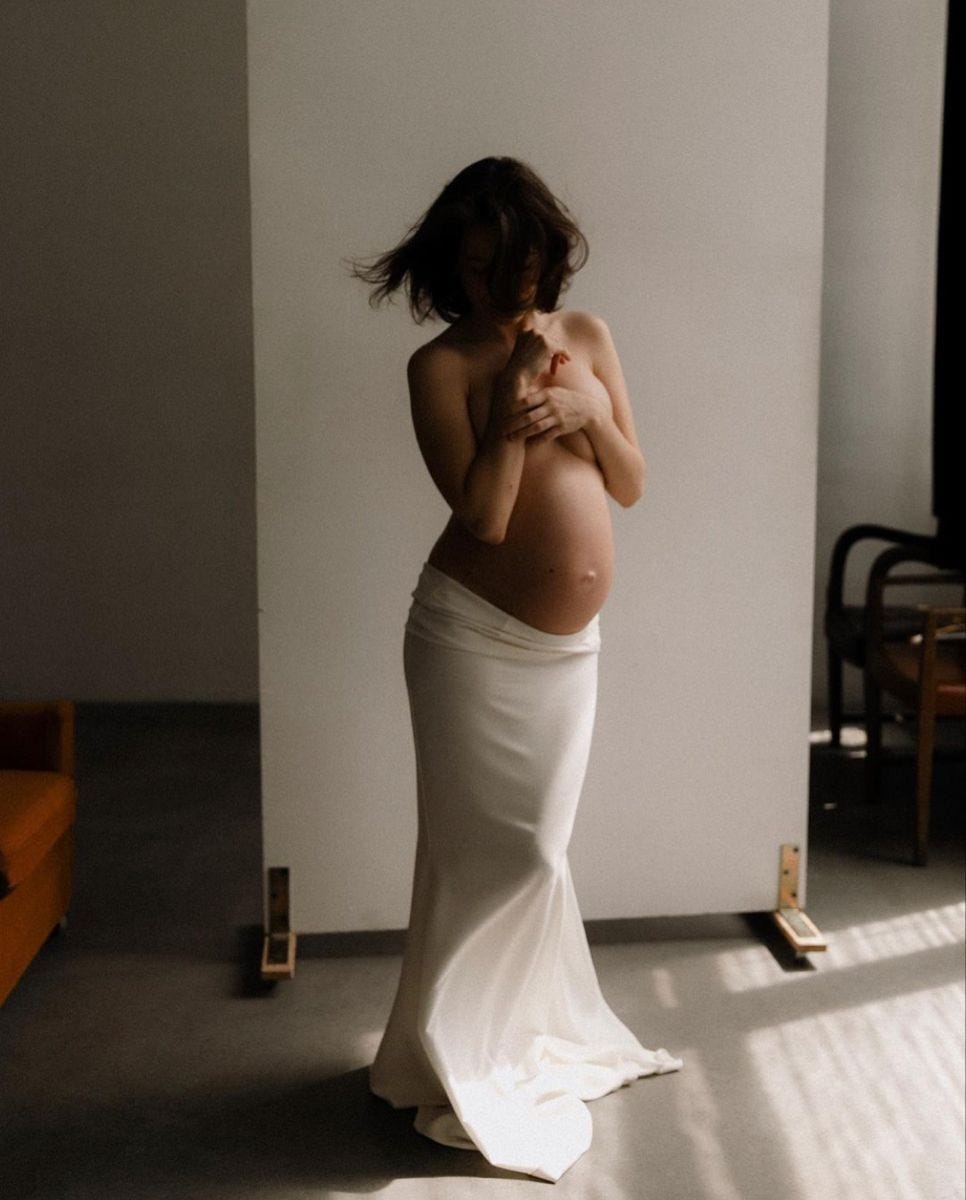
In gestation she is not merely growing tissue. She is transmitting Yuán Jīng directly — endowing the child with its own prenatal inheritance, drawn from her Kidneys, her Chōng and Rèn, her marrow and bone and Blood. The Tibetan medical view names something parallel: the child is formed from the red and white thig-le (bindu), the generative essence-drops of the parents, and the mother spends hers prodigally. Birth, in this reading, is the single largest sanctioned transfer of Jīng a body ever performs.
This is why the postpartum collapse is so severe and so misread by the modern West. The depletion of the yuè zǐ period — the “month” after birth — is not poor character or hormonal bad luck. It is, in the lineage language, a woman running on a hemorrhaged account: Xuè deficient, Qì scattered, the Chōng and Rèn emptied, the Kidney Jīng drawn perilously low. The confinement traditions — Chinese zuò yuèzi (”sitting the month”), the warming yǎng xuè foods, the absolute prohibition on cold, wind, and exertion — were never superstition. They were Jīng-and-Xuè recovery protocols: an entire civilisation’s accumulated knowledge of how to refill the vessel that birth empties.
So the logic looks settled: childbirth depletes, therefore childbirth diminishes radiance. But here the framework, taken too literally, begins to lie.
The controversy, and the deeper truth
From one perspective, pregnancy is pure loss — a hemorrhage of Yuán Jīng, ageing the mother, spending what the texts say cannot be regrown. There is truth in this and plenty of women emerge from unsupported births visibly older, Shén dimmed, Jīng never restored, carrying a depletion that follows them for decades.
But that is only half the cosmology, and I am a living example of how that does not have to be the case.
Pregnancy and postpartum are also one of the most concentrated initiations into feminine surrender a woman will ever be offered — into Yīn in its purest expression: the receptive, yielding, downward-and-inward-flowing principle that is the very ground of feminine radiance. In Tantric terms, birth is a forced dissolution — a death of the maiden-self, a bardo, an enforced encounter with the Dakini's cremation-ground face, Vajrayoginī who destroys what must end so that what is true can be reborn. The depletion and the regeneration are not opposites. They are the same gate…
When a woman fights the process — resists the surrender, bolts back to performance and Yáng doing, treats her postpartum body as a fault to correct, and is held by no one — the yuè zǐ becomes pure expenditure. The Jīng pours out and is never recalled. She ages from it, and the lineages would say she has spent essence to no refinement.
But when a woman submits — when she lets the maiden be undone, treats the dissolution not as catastrophe but as sacred remaking, and is nurtured, warmed, held, and permitted to do nothing but recover — the same event turns regenerative. This is the alchemy of childbirth. The deep parasympathetic surrender that zuò yuèzi was engineered to protect is precisely the state in which the body can rebuild Xuè and consolidate Jīng. Yīn repletion requires stillness, warmth, and safety — the exact conditions surrender produces and resistance destroys. A woman truly held in her confinement emerges not hollowed but deepened: her Shén not dimmed but matured, her radiance carrying a Jīng-density and gravity the maiden never had.
This is the whole of it: the difference between depletion and regeneration is not the event. It is whether she surrenders, and whether she is held.
The same fire that consumes the candle can, under the right conditions, be the heat by which new wax is poured. Childbirth spends essence — yes. But the surrendered, warmed, ritually-held postpartum is one of the rare windows in which a woman’s Chōng and Rèn are primed to refill, in which she can lay down deeper reserves than she carried as a maiden. This is the esoteric meaning beneath the zuò yuèzi prohibitions: protect the surrender, and you protect the regeneration.
What this means for radiance
If beauty is Shén shining through Jīng, then the most radiant women are not those who have spent nothing. They are those who have spent profoundly and been replenished. The maiden’s beauty is borrowed brightness — Jīng not yet drawn upon, tiān guǐ freshly arrived. The mother’s radiance, when she has been carried through her remaking, is the deeper and harder-won thing: essence that has passed through the cremation-ground and returned.
We have built a culture that depletes women — that scatters their Qì, drains their Xuè, and burns their Mìng Mén fire on perpetual Yáng doing — and then sells them the symptoms back as beauty problems. The serum, the procedure, the relentless correction: all of it labours on the flame and the glass while the wax runs out beneath, unattended.
The lineage medicines point elsewhere entirely. Guard your Jīng. Spend it only on what is worthy. And when you spend it greatly, as in birth, demand to be held while you make it again.
That is where radiance actually comes from. Not from what is applied. From what is conserved — and what one is brave enough to surrender to.
And if you have enjoyed reading this, you may also enjoy my latest book, The MotherWild Revolution: Cultural Change through Generational Activism
This is gorgeous. Loving the articulation…Thank you for going deep.