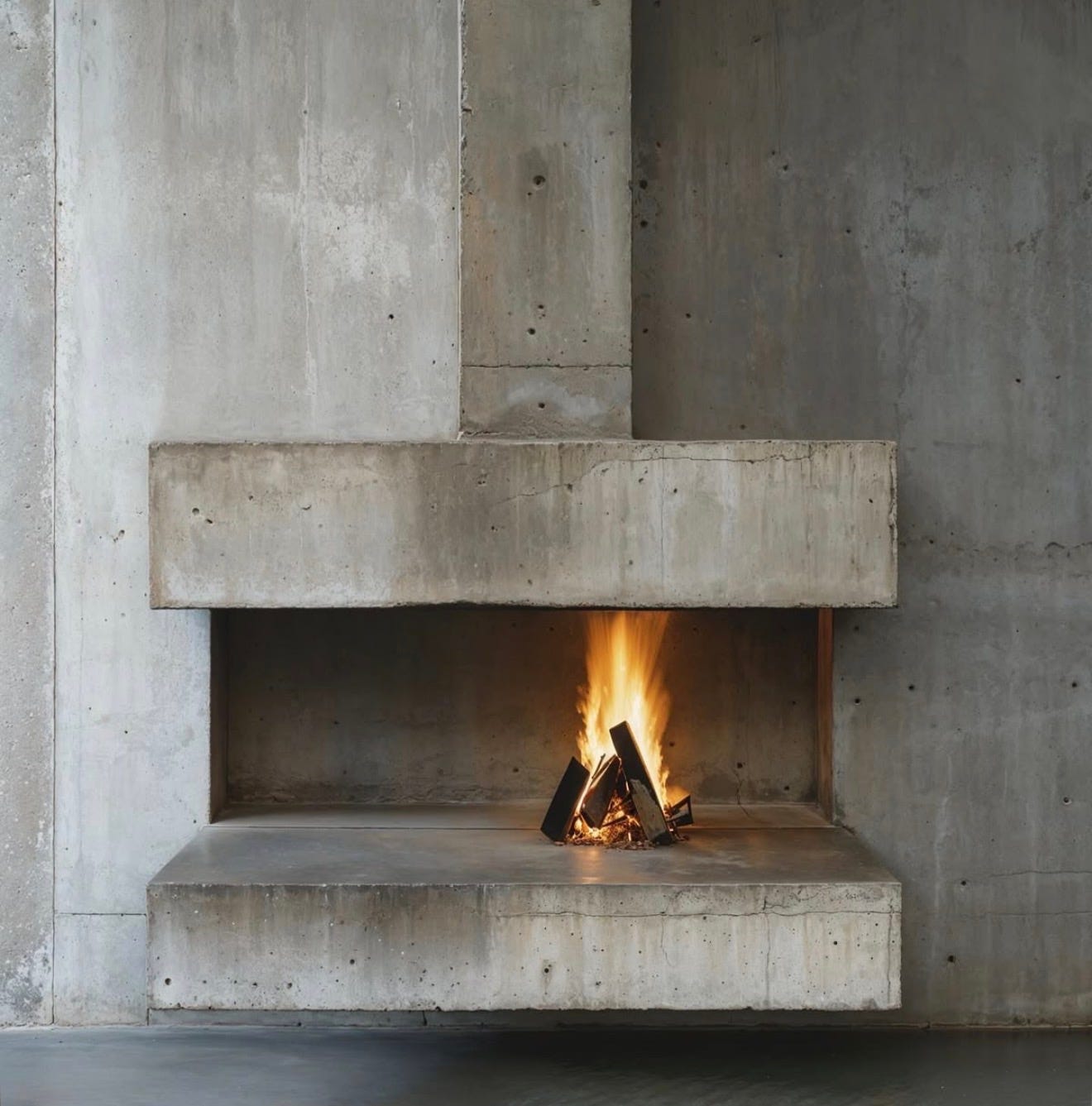
Whenever I see people posting about the bigness of their spiritual life, I always wonder how they tend to their home and daily practice.
I see the ceremonies, the retreats, the downloads, the initiations posted on social media like everyday weather updates and events. I see the altars arranged for the camera and the long captions about awakening. And a quiet question rises in me every time. Who are they when they wake up in the morning, before anyone is watching? Is there warmth in their kitchen, fresh water on their altar, a kettle that knows their hands?
I ask because I have come to believe that the measure of a spiritual life lives and is tended to in the smallest and intricate places. The sacred has always had a home address. For most of human history, that address was the hearth.
The First Temple
Long before churches, ashrams and retreat centres, the fire at the centre of the home was where the sacred lived. It cooked the food, warmed the children, kept the wolves at bay and held the family together through the dark months. To keep the fire alive was to keep life itself alive.
The Greeks gave this fire to Hestia, goddess of the hearth. She has almost no myths and few grand temples, because her temple was every home. She stayed while the other gods went off on their adventures, and she received the first offering at every sacrifice. In Rome she became Vesta, and the Vestal priestesses tended a sacred flame that was never allowed to go out. Even our language remembers her. The Latin word for hearth is focus, the place everything gathers around.
In my own ancestral line, the hearth had its own guardian. In Chinese households the Kitchen God, Zao Jun, kept watch from beside the stove. All year he witnessed how the family lived, how they spoke to one another, how they cared for their elders and their food. Before the New Year he ascended to heaven to report on the household, and families would sweeten his lips with honey or sticky sweets so his words would be kind. The gods, my ancestors understood, were watching what happened in the kitchen.
I love this so much. It means the most intimate surveillance of the divine fell upon the ordinary. Heaven cared how you spoke to your mother over dinner.
Coming Home
I was a yoga and meditation teacher in my twenties, and in my thirties I gave it all up. I also let go of many of my habitual practices, like sitting in plant medicine ceremonies. Something felt off to me. The practices had begun to feel like places I went to, events I attended, identities I wore.
As I deepened into my own self, I found myself naturally drawn towards something far simpler. Daily rituals with tea became my meditation. Boiling the water. Warming the pot. Watching the leaves open. There is an old saying from the Chan tradition, 茶禅一味, tea and Chan are one taste. My body found its way to that teaching long before my mind caught up.
And now, deepening into my Chinese ancestry, I feel more inclined towards practices that connect me into my bloodline. Incense for those who came before me. Offerings of tea. The slow learning of what my grandmothers' grandmothers knew. This came with spiritual maturity, and it has changed where my spiritual life lives. It lives at home now.
Your Spiritual Life Is Your Home Life
In China, spiritual life has long been woven into the household. The ancestral altar sits in the home. Offerings are made in the kitchen and the family room. Rites are passed down through families, learned by watching your mother and grandmother at the altar. Chinese tradition carries little impulse to convert anyone or to announce what you believe. Faith is lived quietly through ritual, through offerings, and through tending to the ancestors, passed from one generation to the next.
This kind of practice belongs to the bloodline. It is shared with family, held within the walls of the home, and largely invisible to the outside world. I don't really share mine publicly anymore, and I have come to see that as a form of protection. Some things grow stronger in the dark, the way roots do.
For me, devotion lives in the small hours now. The pouring of tea. The lighting of incense. Sweeping the floor with intention. Feeding the people I love. Wiping down the bench at the end of the night as a kind of closing prayer. These acts are unglamorous and unseen, and that is exactly where their power lies.
A practice that needs an audience becomes a performance. It starts to bend towards being witnessed. A practice tended in private has only one witness, and it grows roots.
Tending the Fire
Spiritual maturity, for me, has looked like coming home. Quieter, simpler, more rooted. The fire I tend now is small and daily, and it keeps the whole house warm.
I think of Hestia, who stayed. I think of the Kitchen God, keeping his patient watch beside the stove. I think of every woman in my lineage who kept a flame burning, fed her people, and lit incense for her dead without ever calling it a practice. They knew that the sacred is built the way a home is built, one ordinary day at a time.
The big moments have their place. Ceremonies can crack us open, retreats can show us what is possible. Yet the fire that sustains a life is the one you return to each morning, long after the ceremony has ended and the post has been forgotten.
So before the ceremony, before the retreat, before the post, I ask you this. How is your hearth? What do your mornings look like when no one is watching? What do you offer, daily, to the life that holds you?
Is the fire still burning?