Help me turn writing into a career, not just something I do on the side. Your paid subscription helps me carve out real time for essays — the deeper, slower pieces that I can take my time to write whilst I sip my Oolong in the morning.
Paid subscribers get early (and full) access to new essays, occasional behind-the-scenes notes on what I’m working through & monthly live guest speaker interviews. I hope you enjoy this article.
Big love,
SB x
Deep shame can stop the body from feeling like home. You may know it yourself: the heat that floods the face, the eyes dropping to the floor, the chest caving inward as though the heart is trying to hide behind the ribs. The breath goes shallow. Something in you leaves the room while your body stays standing in it. That leaving is the beginning of the split that I want to talk to you about today.
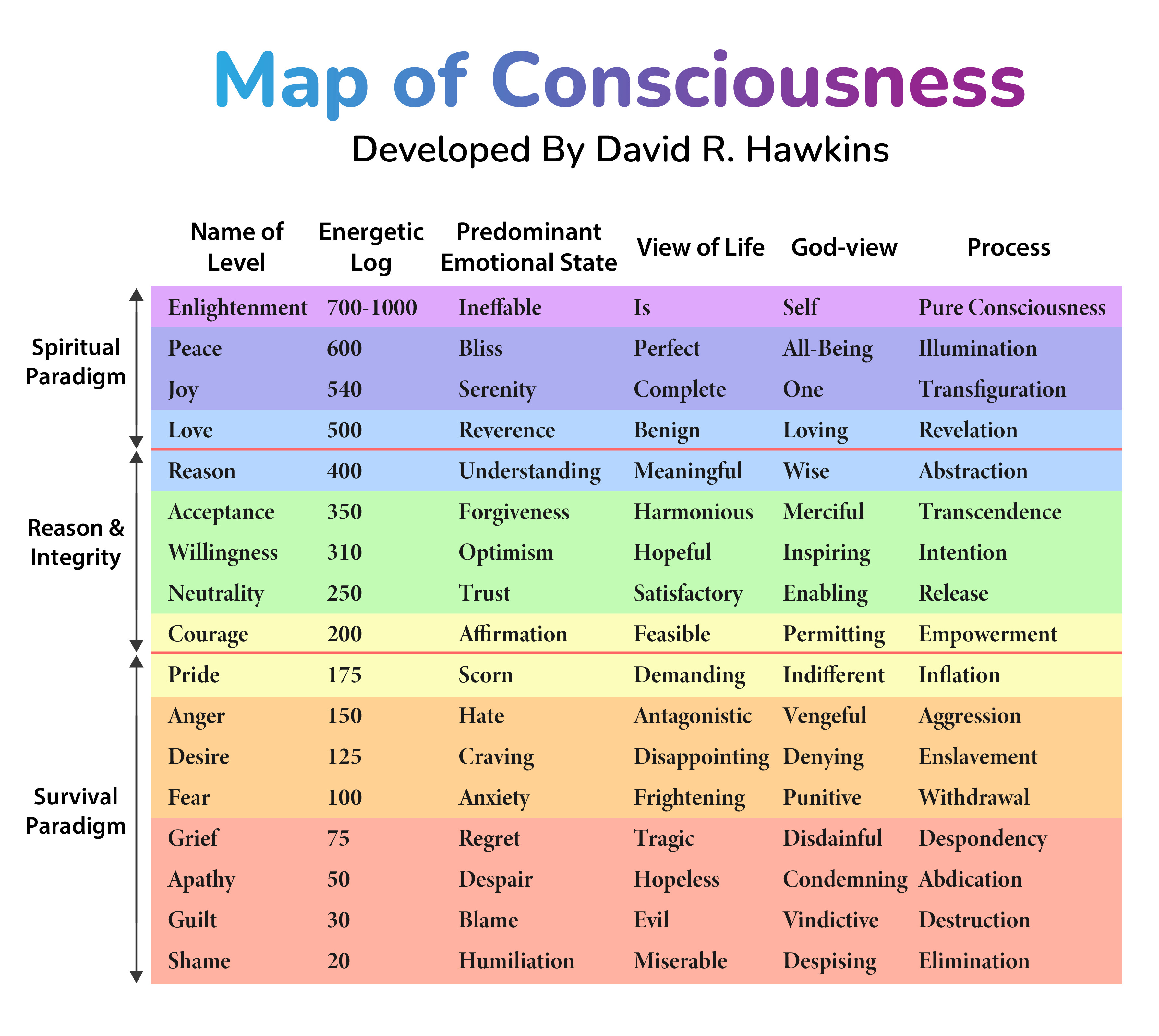
Shame is the most disembodying of all the emotions. The heaviest. Densest. It sits at the bottom of the Scale of Consciousness, with a frequency of just 20Hz. And it stores right down in the base of the spine, in the root system of our body — and so it is sometimes hard to access and hard to track.
Fear mobilises us, and grief, for all its weight, keeps us close to what we loved. Shame does something stranger. It turns the gaze of the whole world inward and makes the body the object of its verdict, and so the self, in an act of survival, steps outside the body to escape the sentence. We learn very young that if the flesh is the thing that is wrong, then the safest place to live is somewhere above it, in the head, in the watching mind, in the careful, managing intellect that monitors the body like a guard monitors a prisoner.
This is how the body-mind split is born Philosophy gave it a name through Descartes, and religion gave it a theology through centuries of teaching that the flesh was fallen, but in the individual psyche it is usually shame that performs the surgery. A child is humiliated for crying, for touching herself, for being too loud, too hungry, too much. The feeling is unbearable, and so the child divides. One part carries the shame and is exiled into the tissues, into the pelvis, the gut, the throat. Another part rises up and away, becoming the good one, the functional one, the one who performs. The body becomes a basement where the unbearable is stored, and the lights are switched off.
Clinically we call this dissociation. Pierre Janet described it over a century ago as a narrowing of consciousness, where parts of experience are split off and held apart from the main current of the self. Modern polyvagal work gives us the physiology: the collapse, the freeze, the dorsal shutdown that shame so often triggers. The body literally dims itself. We know from trauma research that these split-off parts do not disappear. They go on living, often with their own feelings, impulses and ways of speaking, surfacing in moments of stress as though another person has briefly taken the wheel.
The old traditions described this same terrain in a different language.
Across shamanic cultures, the idea of soul loss holds that in moments of overwhelming pain, a fragment of the soul flees the body. In the Tibetan and Vajrayana frameworks I have trained within, there is a detailed understanding of dön and other disturbing forces, which are said to find their way in through weakened vitality, broken vows, grief and emotional disturbance. The Christian mystics spoke of the soul’s inner castle, and of what happens to its gates when the one who lives inside abandons the keep. The shared intuition runs through all of them: a person who has vacated their own body has left a dwelling unattended.
In my years of clinical and esoteric work, the people who carry the deepest shame are very often the same people who describe feeling occupied. They speak of voices that are cruel in a way that feels foreign to them, of compulsions that arrive like weather, of a sense that something is living in the space they themselves have fled. From a psychological lens, we might understand these as introjects, the internalised voice of the shaming parent or the punishing church, now running on its own inside the psyche. From a mystical lens, the tradition would say that the fracture itself became a doorway, and that what moved through it has its own intelligence and its own appetite.
I hold both lenses at once, and I have stopped needing them to cancel each other out. What they agree on is the mechanism. Shame creates a vacancy. The self withdraws from the body, and the body, which was designed to be inhabited, is left open. Whatever we choose to call what enters, whether an introject, a complex, an entity or a spirit, it thrives in the dark basement where shame first put the lights out.
And so the medicine is the same, whichever language you prefer. It is the return.
Healing possession, in this understanding, begins with coming back into the house. It is the slow, tender work of re-inhabiting the tissues you were taught to leave. Breath that reaches the pelvis again. Hands laid on the belly with something closer to reverence than surveillance. Letting the exiled parts speak, letting them be witnessed without the verdict they were originally met with. Shame cannot survive being truly seen with love, because shame is, at its root, the terror of being seen and found wanting. When the one who fled comes home and turns the light on, the occupants who fed on the darkness have far less to hold on to.
The body was never the problem. It was the first place we were taught to abandon, and it remains the place where our sovereignty is restored. Every time you choose to stay present in your flesh while shame rises, you are closing a gap that something else once used as a door. You are reclaiming the house as yours, and a house with its keeper at home is a very difficult place to possess.
I offer 1:1 exorcism work as well as personalised Dark Arts training, to teach you how to work with healing this root split, to occupy your body more deeply and understand when you are being occupied by interference, or the not-self.
What I am noticing lately, is that more and more people are needing this work. As we edge towards the end of Saturns cycle in Pisces (Vedic Astrology) over the next six months, incidences of psychotic breaks will be more common. We are seeing it all over the news — Lindsey Clancy and others, who are on the collective stage, revealing to us the fragility of humanities psyche at the moment.
I am passionate about supporting people to utilise practises to eliminate external interference so that they can hear their own voice. And the loving voice of the creator, who is inherently benevolent.
If you need support with this, you can book a 1:1 session with me, below.